Honors Students Discover Transformative Impact of Faculty-Led Travel
By Phyllis Shier, WSU Honors College – peshier@wsu.edu
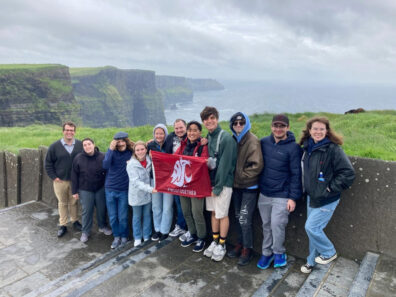 When Colin Criss designed his first faculty-led student trip five years ago, the concept was new to him. Not sure where to start, then English chair Donna Potts advised him to create an experience that would feel significant to him.
“The wheels start to turn, and you start to kind of develop an idea of what a trip could be and how you could make it meaningful with academic study,” Criss said.
Ultimately, his love of Irish poetry led him to Ireland, home to many poets he admires. Now a WSU Honors College faculty member, Criss has successfully led three trips to the Emerald Isle. His eyes twinkle when he says: “The well of Irish poetry is very deep.”
Criss and English faculty member Cameron McGill cohost the honors travel that provides students with firsthand experience of the land that inspires indelible poetry. The two-week summer trip juxtaposes centuries old Irish verse, which Criss identifies as integral to the island’s cultural tapestry, with spectacular scenery and visits with poets in the places they write about. Landscape becomes a point of contact shared between traveler and poet, Criss said.
“It felt like a good way into this larger question of traveling with a meaningful lens.”
Readings prior to the trip prepare students for travel and writing assignments post-trip offer opportunities for retrospection. “Students can think, ‘Okay, I’ve been to the Burren, in the west of Ireland; here’s a poem that’s rooted in the Burren— how does that understanding change my interaction with the landscape?’”
The seminal opportunity to visit with current Irish poets in the regions that influenced them, Criss notes, is invigorating for the poets as well. Discovering what strikes students as surprising and memorable, and discussing their travel experiences often results in conversations that border on magical.
“The base understanding for the trip is that it’s not a vacation. It’s meant to be an enriching, enlightening, meaningful experience and poetry is, I really believe, the tool to make that happen,” Criss said.
Back on campus, students share their creative writing and journaling assignments, recalling travel experiences. “I see how poetry and place have affected the students in the work they produce,” Criss said. The results surpass conventional classroom experience; poetry, Criss says, is the perfect vessel for examining and conveying those impressions.
“I’m trying to get the students to see their experience as a traveler and a tourist in a place they’ve never been before—in a landscape they’ve never been before—through the lens of poetry…it makes the visit very meaningful.”
Students who have been on the trip concur.
“I’ve never been overseas or out of the country so being able to just experience Irish culture… versus what it’s like here, I think that was really cool for me,” current senior Diego Alcaraz said. Even though he found Irish culture similar to American culture, the self-exploration aspect of the trip was most fun. “The thing that kind of made it was immersing myself in the rich history of Ireland and just being there…” he said.
Senior Maddie Eaves became interested in the trip after just one month in Criss’s 280 class. “I feel like this was a really spontaneous experience for me,” she said noting that the trip took her out of her comfort zone and provided unique experiences.
“Through this trip, I met a really close friend… we did everything together; we went swimming in the Irish sea which was seriously so cool,” she said.
The experience also gave Maddie the confidence to apply for a work abroad public relations and marketing internship in Paris.
“Overall, it was such a life-changing trip… to be able to take a 300-level Honors class in a country abroad… with Colin, who is by far the best professor I’ve had at WSU… It was just such a great opportunity,” she said.
Dillon Kamin (’25) also found the trip meant stepping out of his comfort zone. “It had a transformative effect on me, in large part because of the people who were there. We had amazing people,” he said, of the students, poets, faculty, and the grandfatherly bus driver. Going to places like the Cliffs of Moher, Slieve League, Newgrange, and Galway Bay provided lasting impressions.
“So many of these places you’d go to you’d feel such a strong emotion,” Kamin said.
Sometimes that made it difficult to fully process the experience immediately.
“It’s really fun to go and try to unpack it in writing and try to be like ‘What feelings am I feeling and why?’” Kamin said. Putting the trip in words helped to organize those feelings.
“That part was super fun to me—the writing afterward. You’re encouraged to journal and that’s a very valuable part of it. It disturbs your mind and makes you start thinking in new ways and you just want to share about it.”
Among Kamin’s core memories are staying out well into the night, sitting on a lawn deep in discussion for hours.
“It’s transformative; there’s no other way to put it…everything you’re doing is exciting.”
Travel for Criss also made a professional impact, informing his teaching of contemporary Irish poets in ways that keep his courses cutting-edge and unique.
“There are very few courses in contemporary Irish poetry that are focusing on the new Irish poets and it’s exciting to be able to teach that.”
Contemporary Irish poet Stephen Sexton reciprocated the student’s travel, visiting the Pullman campus in spring 2024 to give the Bhatia lecture. Eaves enjoyed reading Sexton’s poems about Super Mario which were actually a metaphor for his mother, who was passing away from cancer. Those works became the basis of her course final.
“There were themes of nostalgia that were really emotional and that’s the kind of material that you’re getting into when you go on this trip which is really neat.”
Three trips later and Criss finds choosing Ireland, its poetry, the inspiring landscape and people who hold poetry as a part of their culture a wise travel abroad choice. After being welcomed into that tradition, Criss said, you can relive the whole experience through language. “The tentacles of the trip are very long.”