Honors Students and Alumni Collaborate on Nature Publication
By Gary Hyatt, WSU Honors College, gary.hyatt1@wsu.edu
The Honors community is proud to celebrate an exceptional collaboration featuring significant contributions from Honors alums and students whose research has been published in Nature, one of the world’s most respected scientific journals.
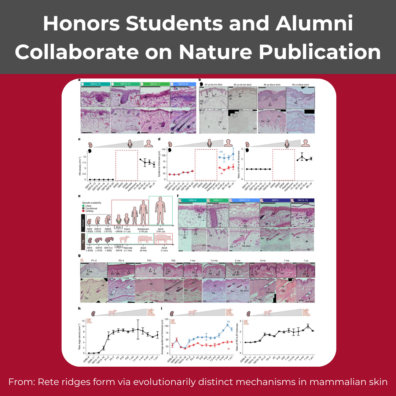
The article, Rete ridges form via evolutionarily distinct mechanisms in mammalian skin, examines how specialized skin structures known as rete ridges develop across mammals. These structures are essential for strengthening the connection between layers of skin and play a critical role in overall skin function. By studying how these features form in different species, the research offers important insights into developmental biology and evolutionary processes, with potential long-term implications for regenerative medicine and wound healing.
This research took place in the lab of Dr. Ryan Driskell at Washington State University and represents a meaningful partnership across multiple years of Honors scholars. Sean Thompson (WSU ’22 and current Ph.D. Student at WSU) has been involved with the research from its early stages and continues to work in the lab, demonstrating sustained commitment to the project and its long-term success.
The publication includes significant contributions from Gabriella “GiGi” Searle (current Honors student), Sean Thompson (WSU ’22), Natalie Williams (WSU ’22), and Isabelle Busch (WSU ’23). Today, Natalie is pursuing medical school and Isabelle recently completed her master’s degree, demonstrating the continued momentum of Honors scholars beyond graduation.
Reflecting on the process, Sean shared that the manuscript was under strenuous review for nearly two years beginning in early 2024, and throughout that intensive period, GiGi was one of the main contributors in the lab to the manuscript’s revisions. His comments underscore the opportunity undergraduate students have to contribute to meaningful, high-impact research at Washington State University.
We congratulate these outstanding scholars on this impressive achievement and invite you to explore the full manuscript of their research here: Rete ridges form via evolutionarily distinct mechanisms in mammalian skin