A Full Circle Return: Dr. Jeffrey Franks Comes Home to WSU Honors
By Gary Hyatt, WSU Honors College, gary.hyatt1@wsu.edu
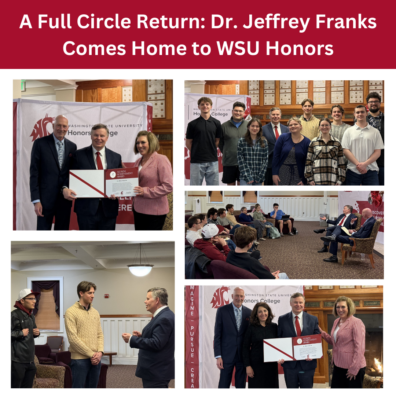 When Dr. Jeffrey Franks returns to the rolling hills of the Palouse this spring to receive the Alumni Achievement Award, it will be more than a ceremony. It will be a homecoming. A Pullman native whose roots at Washington State University run three generations deep, Jeff’s journey has taken him from classrooms in Honors to the highest levels of international economic policymaking. Yet, as he comes back over the hill on the Colfax highway and sees campus with Moscow Mountain in the distance, he knows it will feel familiar: a scholar whose journey began at Washington State University and ultimately spanned more than 70 countries.
A 1984 Washington State University and Honors graduate in Economics and Political Science, Jeff went on to earn master’s degrees from Princeton University and University of Oxford, followed by a Ph.D. from Harvard University.
Over a distinguished 30-year career with the International Monetary Fund, he served in senior leadership roles across Europe, Latin America, and Asia, ultimately becoming Director of the IMF European Office and Senior Resident Representative to the European Union. Now retired from the IMF, he teaches international economics and finance at Georgetown University.
During his visit, Dr. Franks will teach several Honors classes, giving back directly to students and sharing insights from decades of international economic policymaking. He will also meet with faculty and university administrators, as well as connect with a future Distinguished Award finalist.
As he prepares to be recognized by his alma mater, Dr. Franks reflects on his career, his time in Honors, and the lessons he has learned along the way.
1. What would you consider your proudest professional accomplishment?
“I have had many exciting and enjoyable experiences in my career. I have been able to travel to over 70 countries, most of those for work. I have worked on economic crises in Europe, Latin America and Asia. I have been able to meet presidents, prime ministers, and high government officials from many countries and be in the room for important discussions and events. I have genuinely enjoyed every country assignment I have had, from Ecuador to Spain, to Ukraine, to Pakistan, to France.
However, probably my proudest professional accomplishment was to oversee the IMF team for Romania during the global financial crisis. The crisis was sudden and deep, and my team and I, together with colleagues from the EU, the World Bank, and other institutions, were able to help guide Romania through the crisis and back into economic growth. When we started, GDP was falling sharply, the government budget deficit was out of control, and the country was close to a financial crisis. We were able to negotiate and successfully implement a 20 billion euro rescue and reform package. When I left the assignment after 3½ years, the country was growing again, the budget deficit had been tamed, the financial sector was stable, and reforms had been undertaken to make the country more efficient and more sustainable. It was extremely rewarding.”
2. In a full circle moment, what have you most enjoyed about finishing your career in teaching?
“When I met my first adviser in my Ph.D. program at Harvard, he asked me what my career goals were. I responded that ideally, I would like to work for an international organization like the IMF or World Bank, and then end my career by moving into academia, where I could share the knowledge and experiences I had gained. He told me that I had it backwards, and that I should start in academia and then move into an international organization. His logic was that, without building a publication record in academia early on, I would have a hard time getting a job there later in my career. I am pleased to say that I was right and he was also right. He left Harvard after 6 years and went to the World Bank where he became a Vice-President. I, on the other hand, had a more hands-on career at the IMF and was blessed to get the chance to teach International Economics and Finance at Georgetown University upon leaving the Fund. I get to teach my students not just the theory but also share with them my experiences in the trenches of economic policymaking around the world.”
3. When you look back at your time at WSU and in Honors, what lessons or experiences helped you most along the way?
“I had a marvelous experience in Honors at WSU. I found a group of peers who were serious about learning like me. I received excellent instruction from some of the best professors at WSU. I credit the Honors College with preparing me for graduate studies at Princeton, Oxford, and Harvard. My honors classes helped me to write well and to think deeply about topics I didn’t necessarily know a lot about beforehand.
When I arrived at Princeton for a master’s degree, I was initially a little intimidated by all my classmates from Ivy League schools, Stanford, Berkeley, etc. But after the first set of midterms went well, I realized that I was well-prepared and able to compete.”
4. With your international experience and your career with the IMF, what advice would you give a student interested in pursuing a similar path?
“If you are interested in international careers, I think there are two very helpful things you can do to position yourself to take advantage of opportunities when they arise.
The first is to get international experience early on. I did a semester abroad at the University of Costa Rica at the end of my time at WSU. The fact that I had overseas experience was critical to getting an internship the next year with USAID in Somalia. The year after that, I studied at Oxford and was able to travel around Europe a bit, which helped me later to join the European department at the IMF.
The second helpful thing are language skills. I learned Spanish in high school and as a missionary for my church and solidified my knowledge in Costa Rica. This helped me get IMF assignments on Spain, Argentina, and Paraguay and the job heading the IMF office in Ecuador. While at the IMF, I decided to take some French classes offered for free at work. A few years later, I got a call from my boss, who saw I had taken those classes, and asked me to head the IMF teams for France and Belgium. My French wasn’t that great at first, but I kept studying and eventually became fully fluent. That made it possible for me to take on the assignment to head the Paris and Brussels offices toward the end of my career.”
5. Growing up here and now having the opportunity to return to Pullman and WSU to be recognized for your service, what feelings does that stir up?
“My roots at WSU and in Pullman run three generations deep. My father taught here for 40 years. I graduated from WSU. My wife and my brother each have two degrees from WSU, and my sister-in-law got her master’s here. My oldest daughter, Adriana, is an Honors College graduate and her husband got his bachelor’s degree here, too. I am very proud of that, and it makes me happy every time I return. Coming over that hill at the edge of town on the Colfax highway and seeing the university with Moscow Mountain in the distance is always a special feeling.
Getting recognized as a distinguish alumnus is, on the one hand, deeply gratifying, but on the other hand somewhat daunting. Over my career, I have had a certain amount of success, and I am extremely honored to be recognized for those achievements. But my professional life has also brought me into contact with many people who are more successful than I am, Presidents and Prime Ministers, billionaires, Nobel prize winners. So, I am not entirely sure I am distinguished enough to merit this award. What I can say is that I am deeply grateful for the recognition and for all that WSU means to me and my family. Go Cougs!”
From Pullman to global leadership and back again, Dr. Jeffrey Franks reflects the very best of Washington State University and its Honors community. As he returns to receive the Alumni Achievement Award, teach several Honors classes, meet with faculty and administrators, and connect with a future Distinguished Award finalist, his visit will stand not only as a celebration of professional achievement, but as a meaningful act of giving back to the students and institution that helped shape his remarkable journey.
Check out Dr. Jeffrey Franks’ feature in the WSU Insider here
 Name: Emma Soderstrom
 There are moments when scholarship, artistry, and curiosity intersect to reveal something entirely new. That is exactly what Eric McElroy has accomplished in his forthcoming book, Weird Music: Reading John Ireland and Arthur Machen.