Eric McElroy’s Weird Music Explores the Hidden Dialogue Between Music and Literature
By Gary Hyatt, WSU Honors College, gary.hyatt1@wsu.edu
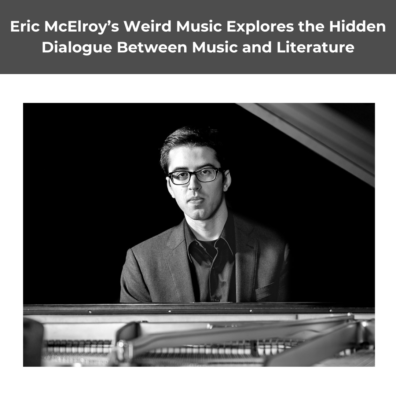 There are moments when scholarship, artistry, and curiosity intersect to reveal something entirely new. That is exactly what Eric McElroy has accomplished in his forthcoming book, Weird Music: Reading John Ireland and Arthur Machen.
Published by Boydell & Brewer as part of the Music in Britain, 1600–2000 series, this new work offers a fresh and compelling lens on the relationship between music and literature in twentieth-century Britain. Drawing on the creative interplay between composer John Ireland and writer Arthur Machen, McElroy explores how “weird fiction” and musical expression intertwine in unexpected and fascinating ways.
A proud graduate of Washington State University and The Honors College, Eric now lives and works in England, where his career continues to flourish as a performer, scholar, and author. The Honors College celebrates this exciting milestone with him and extends its heartfelt congratulations. We are proud of Eric’s accomplishments and grateful to count him among our alumni who are making a meaningful impact in the world.
Q&A with Eric McElroy
1. Congratulations on the upcoming publication of Weird Music! What first inspired you to explore the work of composer John Ireland and writer Arthur Machen in this book?
I first played John Ireland’s music while I was an undergraduate at WSU. I took advantage of the university’s generous interlibrary loan program to get my hands on scores of English music that were, at that time, difficult to find. One of those scores was Sarnia, which is one of the glories of the English piano repertoire, inspired by the composer’s love of the Channel Islands. I have been an admirer of Ireland’s music ever since.
Ireland used to complain about critics, saying, “How can they understand my music if they’ve never read Arthur Machen?” I decided to take him at his word. My book explores the ways in which Machen influenced Ireland’s musical style and worldview by reading Ireland’s compositions alongside Machen’s literary works. It touches on a range of correspondences—shared aesthetics, cultural interests, and more—with the goal of uncovering the hidden meanings Ireland invested in his music.
I focus in particular on Machen’s role in the literary field of weird fiction, a fascinating genre that draws on the uncanny, ghost stories, the supernatural, decadence, and gothic literature. In the book, I argue that Ireland’s life and music display similar qualities, which is where the title Weird Music comes from.
2. Your career spans performance, scholarship, and recording. How did your experience as a musician shape the way you approached writing this book?
Scholars who are also performers approach music from the inside. They are not external commentators but active participants in its cultural history. That personal, physical engagement with music brings a level of authority and authenticity that moves conversations beyond the purely theoretical.
3. For readers who may not be familiar with John Ireland’s music, what makes his work distinctive and worth rediscovering today?
Ireland is a well-known composer in England. His songs and piano pieces are regularly performed, and his liturgical works are part of the standard Anglican repertoire. However, he has never achieved the same level of recognition internationally, which is unfortunate.
His music is richly lyrical and imaginative, and audiences tend to love it when they hear it. His piano works, in particular, deserve greater attention in the United States. Pieces such as Sarnia, Decorations, and the London Pieces would be strong additions to any recital program.
Despite its depth, Ireland’s music has not been the focus of much serious scholarship. This is surprising, given how deeply it engages with themes like landscape, literature, and autobiography. Studying his work helps us better understand how music connects with broader artistic and cultural ideas. It also reminds us that many composers, like Ireland, have been overlooked despite producing work that is just as meaningful as that of more widely recognized figures.
For those new to his music, I recommend starting with The Island Spell and Amberley Wild Brooks.
4. You are an alumnus of the Honors College at Washington State University. How did that experience influence your academic path or shape the way you approach research and creative work today?
The WSU Honors College is a special place. Courses I took there, especially with Professor Robert Eddy, continue to shape my critical thinking.
In addition, grants from the Honors College and the School of Music—where I studied with Dr. Gerald Berthiaume—allowed me to spend a semester abroad in Vienna during my undergraduate years. That experience inspired me to return to Vienna for graduate study, which then led to postgraduate and doctoral work in England. Dean Libby Walker went above and beyond to make this trip possible.
There is a direct line between the opportunities I received at WSU and the work I am doing today.
5. Looking back on your journey from WSU to publishing this book and performing internationally, what advice would you give current Honors College students who hope to pursue careers in the arts or humanities?
- Don’t wait for inspiration. Start writing, and it will eventually arrive.
- Each artist has to come up with their own definition of success. Everything else is distraction.
- You cannot go it alone. Give as much kindness and support to those who come after you as you received on the way up.
- Never forget that being an artist is both a duty and a privilege.
6. How can readers purchase Weird Music?
Weird Music: Reading John Ireland and Arthur Machen is available for pre-order now and will be officially released on March 24, 2026. Readers can purchase the book directly through Boydell & Brewer.
When the interview is published, readers can use the code BB135 to receive a 35% discount, which makes a meaningful difference given the typical cost of academic titles.
The Honors College extends its sincere thanks to Eric McElroy for taking the time to share his insights, experiences, and work with us. We are grateful to be a part of Eric’s story and proud to see the impact he continues to make through his scholarship and artistry.
Order Book Here