Skip to main content Skip to navigation
Washington State University

Honors Students Discover Transformative Impact of Faculty-Led Travel

Honors Students Discover Transformative Impact of Faculty-Led Travel

By Phyllis Shier, WSU Honors College – peshier@wsu.edu
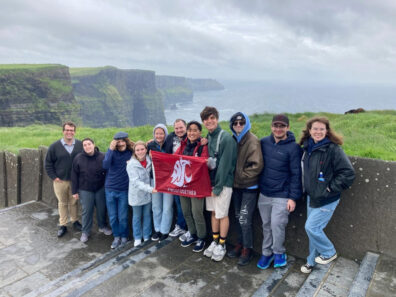
When Colin Criss designed his first faculty-led student trip five years ago, the concept was new to him. Not sure where to start, then English chair Donna Potts advised him to create an experience that would feel significant to him.

“The wheels start to turn, and you start to kind of develop an idea of what a trip could be and how you could make it meaningful with academic study,” Criss said.

Ultimately, his love of Irish poetry led him to Ireland, home to many poets he admires. Now a WSU Honors College faculty member, Criss has successfully led three trips to the Emerald Isle. His eyes twinkle when he says: “The well of Irish poetry is very deep.”

Criss and English faculty member Cameron McGill cohost the honors travel that provides students with firsthand experience of the land that inspires indelible poetry. The two-week summer trip juxtaposes centuries old Irish verse, which Criss identifies as integral to the island’s cultural tapestry, with spectacular scenery and visits with poets in the places they write about. Landscape becomes a point of contact shared between traveler and poet, Criss said.

“It felt like a good way into this larger question of traveling with a meaningful lens.”

Readings prior to the trip prepare students for travel and writing assignments post-trip offer opportunities for retrospection. “Students can think, ‘Okay, I’ve been to the Burren, in the west of Ireland; here’s a poem that’s rooted in the Burren— how does that understanding change my interaction with the landscape?’”

The seminal opportunity to visit with current Irish poets in the regions that influenced them, Criss notes, is invigorating for the poets as well. Discovering what strikes students as surprising and memorable, and discussing their travel experiences often results in conversations that border on magical.

“The base understanding for the trip is that it’s not a vacation. It’s meant to be an enriching, enlightening, meaningful experience and poetry is, I really believe, the tool to make that happen,” Criss said.

Back on campus, students share their creative writing and journaling assignments, recalling travel experiences. “I see how poetry and place have affected the students in the work they produce,” Criss said. The results surpass conventional classroom experience; poetry, Criss says, is the perfect vessel for examining and conveying those impressions.

“I’m trying to get the students to see their experience as a traveler and a tourist in a place they’ve never been before—in a landscape they’ve never been before—through the lens of poetry…it makes the visit very meaningful.”

Students who have been on the trip concur.

“I’ve never been overseas or out of the country so being able to just experience Irish culture… versus what it’s like here, I think that was really cool for me,” current senior Diego Alcaraz said. Even though he found Irish culture similar to American culture, the self-exploration aspect of the trip was most fun. “The thing that kind of made it was immersing myself in the rich history of Ireland and just being there…” he said.

Senior Maddie Eaves became interested in the trip after just one month in Criss’s 280 class. “I feel like this was a really spontaneous experience for me,” she said noting that the trip took her out of her comfort zone and provided unique experiences.

“Through this trip, I met a really close friend… we did everything together; we went swimming in the Irish sea which was seriously so cool,” she said.

The experience also gave Maddie the confidence to apply for a work abroad public relations and marketing internship in Paris.

“Overall, it was such a life-changing trip… to be able to take a 300-level Honors class in a country abroad… with Colin, who is by far the best professor I’ve had at WSU… It was just such a great opportunity,” she said.

Dillon Kamin (’25) also found the trip meant stepping out of his comfort zone. “It had a transformative effect on me, in large part because of the people who were there. We had amazing people,” he said, of the students, poets, faculty, and the grandfatherly bus driver. Going to places like the Cliffs of Moher, Slieve League, Newgrange, and Galway Bay provided lasting impressions.

“So many of these places you’d go to you’d feel such a strong emotion,” Kamin said.

Sometimes that made it difficult to fully process the experience immediately.

“It’s really fun to go and try to unpack it in writing and try to be like ‘What feelings am I feeling and why?’” Kamin said. Putting the trip in words helped to organize those feelings.

“That part was super fun to me—the writing afterward. You’re encouraged to journal and that’s a very valuable part of it. It disturbs your mind and makes you start thinking in new ways and you just want to share about it.”

Among Kamin’s core memories are staying out well into the night, sitting on a lawn deep in discussion for hours.

“It’s transformative; there’s no other way to put it…everything you’re doing is exciting.”

Travel for Criss also made a professional impact, informing his teaching of contemporary Irish poets in ways that keep his courses cutting-edge and unique.

“There are very few courses in contemporary Irish poetry that are focusing on the new Irish poets and it’s exciting to be able to teach that.”

Contemporary Irish poet Stephen Sexton reciprocated the student’s travel, visiting the Pullman campus in spring 2024 to give the Bhatia lecture. Eaves enjoyed reading Sexton’s poems about Super Mario which were actually a metaphor for his mother, who was passing away from cancer. Those works became the basis of her course final.

“There were themes of nostalgia that were really emotional and that’s the kind of material that you’re getting into when you go on this trip which is really neat.”

Three trips later and Criss finds choosing Ireland, its poetry, the inspiring landscape and people who hold poetry as a part of their culture a wise travel abroad choice. After being welcomed into that tradition, Criss said, you can relive the whole experience through language. “The tentacles of the trip are very long.”
Honors Courses Views Crime through Sociological Lens

Honors Courses Views Crime through Sociological Lens

By Phyllis Shier, WSU Honors College – peshier@wsu.edu

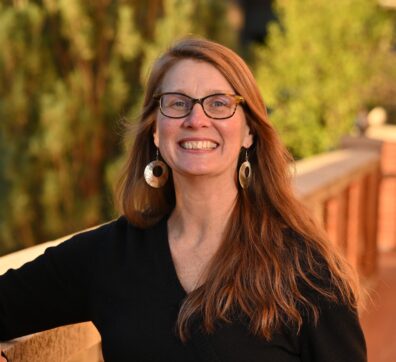
James F. Short Distinguished Professor of Sociology Jennifer Schwartz encourages her students to sleuth in HONORS 370, Global Issues in Social Sciences using statistics to examine global crime trends, patterns, and causes, and to assess societal responses and implications for individuals and communities. Or, as she states in her syllabus, to “demystify crime’s complexities.”

Schwartz created the course as the newest Elma Ryan-Bornander Honors Distinguished Chair, a two-year residency awarded to outstanding WSU faculty members at the forefront of research, pedagogy, and scholarship. The endowment offers two years of salary enhancement, plus funding for research, honors course design, and honors student assistantships.

Providing the new course in her area of expertise allowed Schwartz to systemize her knowledge while seeing things anew from a student’s perspective, she said.

“It’s exciting for me to be able to teach this course with really engaged students who want to discuss the material a lot.”

Schwartz has studied crime patterns and trends for twenty years. In 2019, she focused her research on six rural counties in eastern central Washington where an uptick in incarceration follows a disturbing national trend. According to the Vera Institute of Justice,* who co-funded pilot research in this area, incarceration rates are now highest in America’s rural counties, outpacing urban centers where rates have declined due to reform efforts. This surprising trend defies the fact that rural counties have substantially lower crime rates than cities.

To unpack the problem, Schwartz analyzes booking and release trends of these six jails alongside fellow WSU researcher Jennifer Sherman, who conducts interviews with people who’ve been in one or more of these jails about their experiences. Their work is supported by the National Institute of Justice (NIJ), with additional pilot funding from the Arnold Foundation.

“I’m trying to understand what’s happening and how recidivism or jail reentry fuels some of these patterns and trends,” Schwartz said. NIJ funding allows Schwartz and Sherman to employ a program coordinator and to work with community stakeholder groups that often comprise district court judges, superior court judges, prosecution attorneys, jail administrators, and various social service providers. The researchers compare and contrast their results to draw inferences on big data patterns which, Schwartz said, oftentimes mirror back to stakeholder groups the trends that they already suspect.

“Many people think “oh, jails—they’re holding bad guys, right? It’s not always the case,” Schwartz said. Instead, she found that about 80 percent of people held in rural jails have not been adjudicated.

“It’s people with procedural problems, essentially; they’re legally innocent… or they have not yet been sentenced. People are held pre-trial, so they’ll show up for their case.”

The reality of the trend was nevertheless surprising to the stakeholder groups when Schwartz presented them with the data.

“They sort of had to think, ‘Okay, is this the best use of our time and space—to hold people while they’re waiting for a judge to hear about whether they’re innocent or guilty? —That’s a piece of it—another piece is that these communities need greater access to mental and physical health care and to treatment options for alcohol and drug abuse,” Schwartz said.

Applying a theoretical framework to data analysis works on a multitude of scales and across environments, Schwartz said. In the classroom, she has students apply sociological theories to proactively create successful group dynamics.

Much like crime scene investigators analyze evidence to solve crimes, Schwartz breaks her class into three-person “CSI teams” to investigate crime data from different countries, looking for big picture national trends and social characteristics. Teams apply and compare crime theories across venues for both broad and focused results.

Before they do that, however, each of the CSI groups establishes initial group values and norms and decides how to address problems when norms are broken. Building consensus around core values, anticipating problems, and using conflict resolution techniques, Schwartz said, leads groups to set realistic expectations and desired outcomes. Only then do the CSI groups tackle their assigned nations, studying them as a whole before focusing on how crime problems or different social arrangements lead to certain types of punishments.

“We’re trying to unpack how and why crimes occur and how societies respond to it…,” Schwartz said.

Comparing data across countries gives students perspective on national differences and the social characteristics of places before looking at how they punish.

After studying crime at the global level, Schwartz introduces students to the Washington rural jails research she is conducting, as it exemplifies how we punish in the United States.

“All these processes that we’re unpacking should work at the nation state level, it should work at their team level, and it should work for eastern central Washington; working with these concepts across all different venues—that’s what I’m trying to get them to do.”

Schwartz was drawn to studying criminology in part because of the socially constructed nature of homicide, in which the same mortal outcome isn’t always considered criminal.

“We think about homicide or killing another person, well, in wartime it’s desirable, right?” she said. Another instance where killing may be acceptable is in the case of self-defense. How societies define where the line is drawn between odd behavior, undesirable behavior, and criminal behavior is based on social factors, Schwartz said.

Working in local rural communities allows Schwartz to realize the university’s land grant mission, something that’s very important to her. But these communities can be suspicious of outside support at times, she said, especially from those who don’t comprehend the unique dynamics they face.

“Understanding that we’re coming from a rural community, I think, makes stakeholders willing to work with us. We try to find the low-hanging fruit that can make a big difference in people’s lives with small tweaks and changes. The university’s reputation and land grant mission are helpful—it makes us more trusted.”

Schwartz will receive Bornander funding through 2025. In addition to the new course, she plans to further involve honors students in her research, potentially providing opportunities for students to visit rural communities to observe courtroom processes, to collect and analyze data and create reports, and to conduct interviews.

“I feel very lucky that I’ve been able to be at Washington State this long, to have this research support, and to get these opportunities to work with honors students; it’s been super thrilling.”

Source:

*June 13, 2017 Vera research report:

https://www.vera.org/newsroom/rural-america-has-highest-jail-incarceration-rates-in-the-u-s-despite-low-crime-rates-new-report-reveals

HONORS 198: Student Mentors Ease College Transition, Build Community

HONORS 198: Student Mentors Ease College Transition, Build Community

By Phyllis Shier, WSU Honors College – peshier@wsu.edu

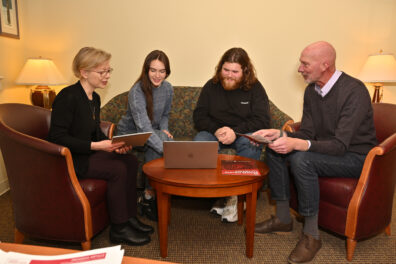
Robin Bond, Honors College Assistant Dean; Emma Johnson, student facilitator; Miles Boudinot, student facilitator; and Grant Norton, Honors College Dean meet to discuss Honors 198

HONORS 198: Honors First-Year Experience is an optional one credit, pass/fail course, offered every fall to ease transition to college and to promote student retention and success. Sections are capped at fifteen students for a low-key, collegial environment with eleven sections offered this fall. Incoming students learn about clubs and undergraduate research, internships, study abroad, and applying for awards and scholarships. They receive advice on registration, resume building, and on preparing for interviews.

“The idea was to come up with a first semester class to help students feel connected to the Honors College and community,” said course leader Assistant Dean Robin Bond. While many honors programs offer a similar course, having it led by students is unique to WSU. “Right from the start, it was decided that it would be taught by Honors students, so it would be a peer mentoring program as well.”

Facilitators are recruited as early as sophomore year, so classes are advised by peers who recall the first-year experience. Emma Johnson was invited to teach by Bond and Griffin Rinauro, the student who taught her. “My freshman year facilitator…inspired me to work hard and to follow my passion. It’s an honor to be part of such a high-achieving and supportive group,” Johnson said.

Miles Boudinot took the course and became a facilitator this year. “Honors 198 provided me an opportunity to breathe during my first semester. My facilitators did a tremendous job at serving as resources for my questions and concerns as I made that transition.”

Last year, Bond presented on HONORS 198 at the National Collegiate Honors Council conference in Chicago. “People were really excited to know more about how it works, how students are chosen, and how they’re trained to lead their own classes,” she said. Prior to leading courses, incoming facilitators meet as a group to learn program goals and to explore honors community and facilitator values. “Belonging” is a value that often arises. “We really want new students to feel that their facilitators are mentors who can help them with that,” Bond explained.

Two sections of HONORS 198, focused on building leadership awareness, are co-facilitated by Bond and Dean Norton. “Oftentimes there will be students in my leadership section where I think ‘that person would make a great facilitator,’” Bond said. Students like Boudinot and Johnson.

“I hope first-year students leave with a sense that their WSU experience is uniquely theirs and that they have the potential to make a meaningful impact. Above all, I want them to know they can always lean on the supportive honors community we’ve built together,” Johnson said.