Skip to main content Skip to navigation
Washington State University

Honors Students Shine Among WSU Top Ten Seniors

Honors Students Shine Among WSU Top Ten Seniors

By Gary Hyatt, WSU Honors College, gary.hyatt1@wsu.edu

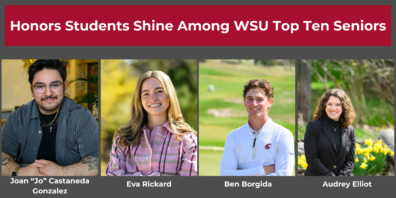
The Honors College at Washington State University proudly celebrated four outstanding seniors who were selected as members of Washington State University’s 2026 Top Ten Seniors class one of the university’s highest student recognitions.

Joan “Jo” Castaneda Gonzalez, Eva Rickard, Ben Borgida, and Audrey Elliot were recognized for exemplifying excellence in academics, leadership, service, athletics, research, and community impact. Selected by the Washington State University Alumni Association, the Top Ten Seniors award honors students who represent the very best of the Cougar experience.

Jo Castaneda Gonzalez, recognized in academics, distinguished herself through groundbreaking undergraduate research, national scholarship recognition, and leadership in STEM mentoring programs. She will continue her academic journey this fall pursuing a PhD in organic chemistry at the University of Minnesota.

Eva Rickard, also recognized in academics, earned numerous research awards while conducting Alzheimer’s and dementia research at WSU. A Goldwater Award recipient and future medical student, Eva exemplifies the Honors College commitment to research and service.

Ben Borgida was recognized in athletics for his success as a member of the WSU men’s golf team while also serving in numerous leadership roles across campus athletics. In addition to his academic accomplishments in biology, Ben helped found Athletes in STEM, creating community and support for student-athletes pursuing demanding academic pathways.

Audrey Elliot was honored in community service for her exceptional involvement and leadership across numerous organizations dedicated to mental health awareness, sustainability, education, and community engagement. From leading the WSU Country Swing Club to volunteering with organizations throughout the Palouse, Audrey’s commitment to serving others reflects the heart of the Cougar spirit.

Together, their accomplishments reflect the strength of the Honors experience and the opportunities available to students who strive to lead both inside and outside the classroom.

The Honors College congratulates Jo, Eva, Ben, and Audrey on this extraordinary achievement. Go Cougs!

Read more about the Top 10 Graduates: WSU Top Ten Seniors | Washington State University

A Night of Recognition and Celebration for the Honors College Class of 2026

A Night of Recognition and Celebration for the Honors College Class of 2026

By Gary Hyatt, WSU Honors College, gary.hyatt1@wsu.edu

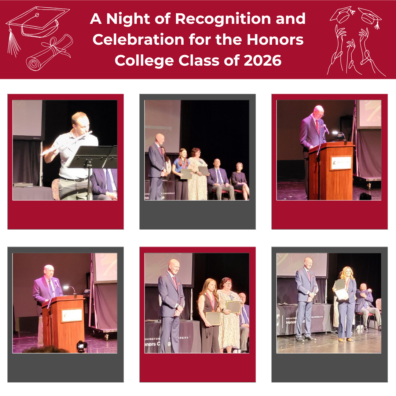
The Honors College at Washington State University celebrated the Class of 2026 during its annual commencement ceremony. The evening highlighted the academic excellence, service, research, and creativity that define the Honors experience at WSU.

The ceremony featured a musical performance by Jordan Slaughter, who performed East Wind by Shulamit Ran, adding a memorable artistic touch to the celebration. Graduates and guests also heard remarks from retiring Associate Dean David Shier, whose years of service and dedication to Honors students have had a lasting impact on the honors college community.

As part of the ceremony, each graduate received an Honors medallion to be worn during the university-wide commencement ceremonies, symbolizing their achievements and membership in the Honors College community.

A special tradition of the ceremony included recognizing the Honors College Gonfalon Bearers, students selected for their outstanding academic achievement and leadership to represent the college during university commencement ceremonies. This year’s honorees were John Crowley, Jasmin Chu, and Miles Boudinot.

The prestigious S. Town Stephenson Award, one of the highest recognitions presented by the Honors Council, was awarded to four exceptional graduates whose academic accomplishments, intellectual curiosity, and diverse commitments distinguished them throughout their undergraduate careers. The 2026 recipients included Ben Borgida, Matthew Bunge, Katelyn Smith, and Nitara Sukumaran.

The ceremony also recognized faculty mentors whose guidance helped shape the academic journeys of Honors students through the Outstanding Thesis Advisor Awards. This year’s recipients included Dr. Porismita Borah, Dr. Joe Compeau, Dr. Wes Dowd, Dr. Minjoo Kim, Dr. Sergey Lapin, Dr. Pavan Munaganti, Dr. Amanda Stahl, and Dr. Aaron Wacker.

The Spring 2026 Faculty Award was presented to Dr. Shawna Herzog, associate professor of history, in recognition of her outstanding teaching, mentorship, and commitment to Honors students. Known for challenging students to think deeply and independently, Herzog has served the Honors College in numerous capacities, including as an Honors Faculty Fellow and member of the Honors Council.

The evening concluded with the presentation of the Dean’s Award, honoring graduating seniors who exemplify the mission and values of the Honors College through academic excellence, service, and commitment to others. This year’s recipients were Emma Soderstrom and Eva Rickard.

As graduates received one final standing ovation from family, friends, faculty, and staff, the ceremony served as both a celebration of achievement and a sendoff into the next chapter of their lives. Congratulations to the Honors College Class of 2026 and Go Cougs!

Honors Cougs Represent WSU at Western Regional Honors Council Conference

Honors Cougs Represent WSU at Western Regional Honors Council Conference

By Gary Hyatt, WSU Honors College, gary.hyatt1@wsu.edu

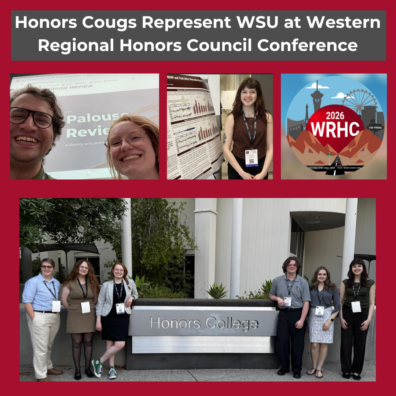
Students from the Honors College at Washington State University traveled to Las Vegas to present their work at the 2026 Western Regional Honors Council Conference 2026, held April 9–11 at University of Nevada, Las Vegas. This year’s theme, “Battle Born: Crossroads and Opportunities,” highlighted resilience, growth, and the defining moments that shape academic and personal journeys.

A delegation of six Washington State Honors students and two faculty members attended the conference, joining peers from across the western United States to share ideas, connect across disciplines, and showcase high-level undergraduate scholarship.

  •  Maya Nash presented “Top-Down Prelimbic Cortical Regulation of the Paraventricular Thalamus Gates Heroin Seeking in Rats.”
  • Allison Mata presented “Searching for Supermassive Black Hole Binaries.”
  •  Bruce Redden presented “Crossroads in Therapy: Developing Novel H. pylori Therapeutics.”
  • April Witham, alongside faculty advisor Colin Criss, presented on Student Publishing in Honors: The Palouse Review.
  •  Nicole Diefenbach presented “Pathological BDNF and TrkB Mutations Affect Synaptic Development.”
  • Katy Touretsky presented “Cannabis Vapor in Adolescence: Effects on Behavior and Microglia.”

Together, these students represented the Honors College with professionalism and purpose, contributing to conversations that reflect the conference’s focus on navigating crossroads and embracing opportunity. Their presence at the Western Regional Honors Council Conference underscores Washington State University’s commitment to fostering student scholarship, collaboration, and leadership on a regional stage.

Honors Faculty Spotlight: Annie Lampman and the Launch of The Origin of Ava

Honors Faculty Spotlight: Annie Lampman and the Launch of The Origin of Ava

By Gary Hyatt, WSU Honors College, gary.hyatt1@wsu.edu

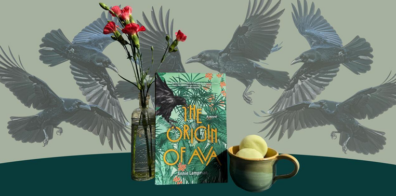
We are thrilled to celebrate the latest literary achievement of our own Honors Faculty member, Annie Lampman. Available now, Annie’s newest novel, The Origin of Ava, weaves together the lives of three unforgettable characters whose paths collide through fate, flight, and the healing power of nature. Drawing readers into the wilderness of Idaho and the lush landscapes of Ecuador, Annie explores themes of loss, renewal, and the profound connections between humans and the natural world.

A prolific writer, Annie is also the author of the award-winning Sins of the Bees and the poetry chapbook Burning Time, with her work appearing in over seventy literary journals and anthologies. She has been recognized with the American Fiction Award for Crime Thriller, the Dogwood Literary Award in Fiction, a Pushcart Prize special mention, and multiple Best American Essays “Notable” selections.

In this Q&A, Annie shares insights into her writing process, the inspiration behind The Origin of Ava, and how her passions for birdwatching, pollinator gardening, and restoration of historic homes influence her storytelling.

1. Congratulations on the release of The Origin of Ava! What first sparked the idea for this novel, and how did the story begin to take shape for you?

I grew up in Headquarters, ID spending my summers on the North Fork of the Clearwater River, and this book is essentially my love letter to that most sacred of family places, along with the high country that surrounds it. Perhaps the most important real-life event that formed The Origin of Ava was the Steep Corner Wildfire on August 12, 2012 that killed a 20-year-old female wildland firefighter. That day, my family and I were returning from a backpacking trip into Goat Lake, driving along the North Fork of the Clearwater River, when my wildland firefighter husband, Steve, and I spotted a huge mushroom cloud of wildfire smoke billowing ahead. We knew immediately it was bad, but then when one after another emergency vehicle passed us on the isolated backroad, lights and sirens blasting, we knew with sinking hearts it was worse than bad. At the time, we’d moved out of the Headquarters backwoods to the college town of Moscow, ID for my MFA in creative writing at the University of Idaho, and once we were home, we found out the firefighter who’d been killed was a Moscow local and a UI student, and the agency that had been in charge of the fire was my husband’s former employer. We, like everyone else, were devastated by the news. A few years later, two of our sons ended up working on the same wildland fire crew as the fallen firefighter and were tasked with establishing and upkeeping a woodland sanctuary dedicated to her. It was all very poignant, connected to our whole life in that place and its human/environmental experience, and it’s never left me, eventually turning into an award-winning short story (“Whom the Lion Seeks” Dogwood Fiction Award, judged by Phil Klay) and then into The Origin of Ava, serving as the hub around which the whole novel circles.

2. Nature and birds appear to play an important role in the book. How does your own interest in birdwatching and the natural world influence your storytelling?

Having grown up in a remote and forgotten place surrounded by uninhabited forest wilderness punctuated by lawlessness and constantly-looming human and environmental threat, I find myself always writing about settings where the natural world is a driving force, inhabiting the story as much as the characters, shaping the story’s emotional tenor, functioning as its beating heart. Remote settings and their related flora, fauna, and natural phenomena often demonstrate both intense beauty and intense hardship, highlighting everything in society over which I celebrate or despair. The places that inhabit my work have everything to do with who the characters are and what the characters do. I can’t even conceptualize a story without knowing, intimately and personally, its place of being so I typically write about places I know, places that I’ve experienced in some way personally. This is how the story of my characters arrives—their story in the midst of their place. Whether a micro focus or a macro focus, landscapes can inhabit the world of fiction in a way that not only enriches the story itself, but also readers’ experience of that story: its particular world, its characterizations, its emotions, and its movements both large and small. That’s what I strive for in my own work—nature/place functioning as a main force in and of itself, even as a kind of main character.

3. You’ve published poetry, essays, and another novel. How did writing a novel like The Origin of Ava challenge or stretch you as a writer compared to your previous work?

Each piece of writing poses its own unique challenge, whether a five-line poem, a ten-page personal essay, or a 300-page novel. As the latter, The Origin of Ava had two distinct challenges for me, the first of which was a writerly challenge I set for myself, had a lot of fun with, but often found really nettlesome: how to connect three disparate characters and their specific situations together into a satisfying whole—namely a disillusioned ornithologist professor moving from the Palouse to Ecuador; a backwoods Idaho runaway girl with pack llamas; and an ex-convict wildland firefighter jumping parole on a container ship. The second challenge was weaving in real-life stories and myth into this already stacked deck, such as the stories of 1800s miner Billie Rhodes, the Ridge Runner, Sacajawea, and my own personal family lore.

4. You teach in The Honors College at Washington State University. How has your experience working with Honors students influenced you as a writer or shaped the way you think about storytelling? In turn, how has writing a book while working at The Honors College made you a better teacher?

In the last decade working at the WSU Honors College, as a practicing writer (actively practicing the art you teach is always a big bonus as far as the lived experience informing the craft as well as the teaching of the craft!) I have honed my central narratives, come to understand my core concerns and conceits, and matured into my own writing style. Part of this is just the expected outcome and natural process for any artist after years of effort, but part of it is also directly related to teaching creative writing courses for Honors, particularly as connected to the MESI program (mindfulness-based emotional and social intelligence), and most particularly nature-based mindfulness. In encouraging my students to foster their own writing craft with joy, empathy, self-compassion, and a deep sensory observation of the natural (and human) world, I have better adopted the same strategies for myself and both my writing work and my teaching work have benefitted from it.

5. Parts of the novel are set in the Palouse and nearby Idaho. What makes this region such a compelling place to write about?

  • I deeply know it, understand it, and love it—its flora, fauna, natural phenomena, histories, and dramas
  • It is full of drama, from the prairie’s skies, fields, and winds to the mountain’s forests, peaks, and wild waters, not to mention all the human histories, both triumphant and tragic. There’s no end to the drama wherever you look, and as a novelist, drama is part and parcel of the gig!

To purchase Annie’s book click here- The Origin of Ava | torrey-house-press

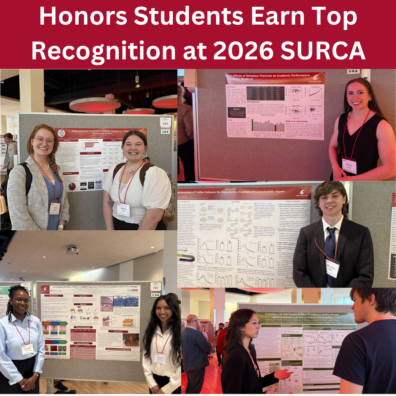
Honors Students Earn Top Recognition at 2026 SURCA

Honors Students Earn Top Recognition at 2026 SURCA

By Gary Hyatt, WSU Honors College, gary.hyatt1@wsu.edu

Students from the Washington State University Honors College delivered an outstanding showing at this year’s Showcase for Undergraduate Research and Creative Activities (SURCA), earning top honors across multiple disciplines and award categories.

SURCA, one of WSU’s premier academic events, highlights undergraduate research and creative work across nine fields of study. Awards are given at several levels, including the prestigious Crimson Award for top-scoring presentations, the Gray Award for high achievement, as well as Early Career and Novice Researcher Awards recognizing emerging scholars.

This year, Honors students distinguished themselves with an impressive list of award-winning projects:

Crimson Award (Highest Distinction)

• Myah Winters – Applied Sciences
• Charles Liu – Computer Science, Mathematics, Statistics, and Information Sciences
• Danika Dalvi – EschLEAD Scholar; also recognized in Molecular, Cellular, and Chemical Biology
• Dani Lindenfelser – Molecular, Cellular, and Chemical Biology
• Nicolas DiPietro – Organismal, Population, Ecological, and Evolutionary Biology
• Sally Wierenga – Social Sciences
• Tanner Morford – Social Sciences

Early Career Award

• Cole Wilson – Computer Science, Mathematics, Statistics, and Information Sciences
• Chantelle Awendo – EschLEAD Scholar

Gray Award (Second Highest Honor)

• Katherine Cooper – Applied Sciences
• Johnathon Whitacre – Arts & Design
• Rowan Spencer – Engineering & Physical Sciences
• Gabriella Searle – EschLEAD Scholar; also recognized in Molecular, Cellular, and Chemical Biology
• Nicole Diefenbach – Molecular, Cellular, and Chemical Biology
• Sawyer Hicks – Molecular, Cellular, and Chemical Biology
• Tiana LaFollette – Molecular, Cellular, and Chemical Biology
• Maya Nash – Molecular, Cellular, and Chemical Biology
• Sophia Cederholm – Social Sciences

Novice Researcher Award

• Addison Manter – Organismal, Population, Ecological, and Evolutionary Biology

In total, Honors students were recognized across nearly every major SURCA category, demonstrating both the breadth and depth of undergraduate research within the college.

Beyond the awards themselves, participation in SURCA reflects the Honors College mission to foster intellectual curiosity, critical thinking, and meaningful faculty-student collaboration. From advancing cancer therapeutics and cybersecurity to exploring identity, sustainability, and human behavior, these projects represent work that reaches far beyond the classroom.

The success of these students underscores the strength of the Honors experience at WSU. Through research opportunities like SURCA, Honors Cougs continue to develop as scholars, innovators, and leaders prepared to make a lasting impact in their communities and professions.

Student Perspective: Emma Soderstrom

Student Perspective: Emma Soderstrom

By Gary Hyatt, WSU Honors College, gary.hyatt1@wsu.edu

Name: Emma Soderstrom

Year: Senior

Hometown: Phoenix, Arizona

Major: Political Science, Criminal Justice & Criminology

Minor: Chinese Language, Philosophy

How has The Honors College impacted your time at WSU?

Being a student in the WSU Honors College has truly shaped my experience in Pullman. The close-knit community of Honors has allowed me to be supported by both faculty and peers, shaping my sense of belonging at WSU. Through getting involved in undergraduate research and embracing the study of foreign languages, The Honors College has pushed me to become a better student, and I am incredibly grateful.

Most impactful Involvement/Leadership/Research you have engaged in and what each entail:

The most impactful involvement I have engaged in was being an Honors 198 facilitator. There, a co-facilitator and I led weekly class meetings of a dozen Honors first-year students. It was incredibly meaningful helping support the newest members of our community navigate the transition to university life in the same way I was supported by those before me.

One of my favorites leadership positions I held at WSU was being the Vice President of Inclusion for my sorority. There, I helped ensure member well-being and advocated for the interests and belonging of all our members. It was a great experience leading our group of over 100 women.

The summer following my junior year, I worked with an REU, a National Science Foundation funded summer research experience for undergraduates. I was fortunate enough to be accepted to an REU hosted by WSU’s Department of Criminal Justice, where we analyzed police body worn camera footage of intimate partner violence. An entirely self-directed project, I focused on how police decision making changes, if at all, when children are present for such violence. Motivated by my work that summer and the impact research has on communities, I expanded on this research for my Honors Thesis.

Career Goal/ Future education plans:

After graduating this spring, I intend to attend law school starting in the Fall of 2026. I am currently in the process of deciding which school to attend, though I am very fortunate to have already been admitted to several incredible schools that will set myself up well following law school. As an attorney, I intend to work in public service.

Favorite Honors Course and why?

My favorite Honors Course was Honors 370: Global Issues in the Social Sciences. This was one of my first classes I took at WSU and was an incredible introduction to the Honors curriculum. The focus of the class this semester was on global poverty. I learned so much about interdisciplinary approaches in the social sciences and truly developed a great foundation of knowledge for the remained of my courses.

Advice for an incoming Honors student?

Get involved! The value of having a community to support you and learn from cannot be understated.

Lastly, what are some things outside of your academic journey you enjoy doing?

Outside of classes, I love playing volleyball. Recently, I even started coaching WSU’s club volleyball team.

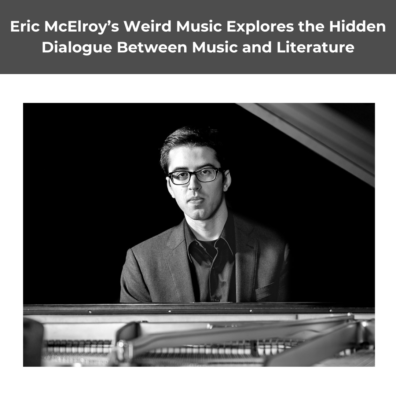
Eric McElroy’s Weird Music Explores the Hidden Dialogue Between Music and Literature

Eric McElroy’s Weird Music Explores the Hidden Dialogue Between Music and Literature

By Gary Hyatt, WSU Honors College, gary.hyatt1@wsu.edu

There are moments when scholarship, artistry, and curiosity intersect to reveal something entirely new. That is exactly what Eric McElroy has accomplished in his forthcoming book, Weird Music: Reading John Ireland and Arthur Machen.

Published by Boydell & Brewer as part of the Music in Britain, 1600–2000 series, this new work offers a fresh and compelling lens on the relationship between music and literature in twentieth-century Britain. Drawing on the creative interplay between composer John Ireland and writer Arthur Machen, McElroy explores how “weird fiction” and musical expression intertwine in unexpected and fascinating ways.

A proud graduate of Washington State University and The Honors College, Eric now lives and works in England, where his career continues to flourish as a performer, scholar, and author. The Honors College celebrates this exciting milestone with him and extends its heartfelt congratulations. We are proud of Eric’s accomplishments and grateful to count him among our alumni who are making a meaningful impact in the world.

Q&A with Eric McElroy

1. Congratulations on the upcoming publication of Weird Music! What first inspired you to explore the work of composer John Ireland and writer Arthur Machen in this book?

I first played John Ireland’s music while I was an undergraduate at WSU. I took advantage of the university’s generous interlibrary loan program to get my hands on scores of English music that were, at that time, difficult to find. One of those scores was Sarnia, which is one of the glories of the English piano repertoire, inspired by the composer’s love of the Channel Islands. I have been an admirer of Ireland’s music ever since.

Ireland used to complain about critics, saying, “How can they understand my music if they’ve never read Arthur Machen?” I decided to take him at his word. My book explores the ways in which Machen influenced Ireland’s musical style and worldview by reading Ireland’s compositions alongside Machen’s literary works. It touches on a range of correspondences—shared aesthetics, cultural interests, and more—with the goal of uncovering the hidden meanings Ireland invested in his music.

I focus in particular on Machen’s role in the literary field of weird fiction, a fascinating genre that draws on the uncanny, ghost stories, the supernatural, decadence, and gothic literature. In the book, I argue that Ireland’s life and music display similar qualities, which is where the title Weird Music comes from.

2. Your career spans performance, scholarship, and recording. How did your experience as a musician shape the way you approached writing this book?

Scholars who are also performers approach music from the inside. They are not external commentators but active participants in its cultural history. That personal, physical engagement with music brings a level of authority and authenticity that moves conversations beyond the purely theoretical.

3. For readers who may not be familiar with John Ireland’s music, what makes his work distinctive and worth rediscovering today?

Ireland is a well-known composer in England. His songs and piano pieces are regularly performed, and his liturgical works are part of the standard Anglican repertoire. However, he has never achieved the same level of recognition internationally, which is unfortunate.

His music is richly lyrical and imaginative, and audiences tend to love it when they hear it. His piano works, in particular, deserve greater attention in the United States. Pieces such as Sarnia, Decorations, and the London Pieces would be strong additions to any recital program.

Despite its depth, Ireland’s music has not been the focus of much serious scholarship. This is surprising, given how deeply it engages with themes like landscape, literature, and autobiography. Studying his work helps us better understand how music connects with broader artistic and cultural ideas. It also reminds us that many composers, like Ireland, have been overlooked despite producing work that is just as meaningful as that of more widely recognized figures.

For those new to his music, I recommend starting with The Island Spell and Amberley Wild Brooks.

4. You are an alumnus of the Honors College at Washington State University. How did that experience influence your academic path or shape the way you approach research and creative work today?

The WSU Honors College is a special place. Courses I took there, especially with Professor Robert Eddy, continue to shape my critical thinking.
In addition, grants from the Honors College and the School of Music—where I studied with Dr. Gerald Berthiaume—allowed me to spend a semester abroad in Vienna during my undergraduate years. That experience inspired me to return to Vienna for graduate study, which then led to postgraduate and doctoral work in England. Dean Libby Walker went above and beyond to make this trip possible.
There is a direct line between the opportunities I received at WSU and the work I am doing today.

5. Looking back on your journey from WSU to publishing this book and performing internationally, what advice would you give current Honors College students who hope to pursue careers in the arts or humanities?

  1. Don’t wait for inspiration. Start writing, and it will eventually arrive.
  2. Each artist has to come up with their own definition of success. Everything else is distraction.
  3. You cannot go it alone. Give as much kindness and support to those who come after you as you received on the way up.
  4. Never forget that being an artist is both a duty and a privilege.

6. How can readers purchase Weird Music?

Weird Music: Reading John Ireland and Arthur Machen is available for pre-order now and will be officially released on March 24, 2026. Readers can purchase the book directly through Boydell & Brewer.

When the interview is published, readers can use the code BB135 to receive a 35% discount, which makes a meaningful difference given the typical cost of academic titles.

The Honors College extends its sincere thanks to Eric McElroy for taking the time to share his insights, experiences, and work with us. We are grateful to be a part of Eric’s story and proud to see the impact he continues to make through his scholarship and artistry.

Order Book Here

A Full Circle Return: Dr. Jeffrey Franks Comes Home to WSU Honors

A Full Circle Return: Dr. Jeffrey Franks Comes Home to WSU Honors

By Gary Hyatt, WSU Honors College, gary.hyatt1@wsu.edu
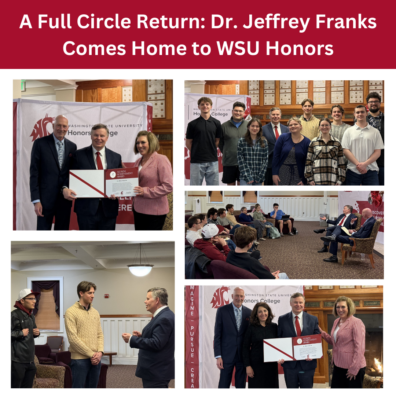
When Dr. Jeffrey Franks returns to the rolling hills of the Palouse this spring to receive the Alumni Achievement Award, it will be more than a ceremony. It will be a homecoming. A Pullman native whose roots at Washington State University run three generations deep, Jeff’s journey has taken him from classrooms in Honors to the highest levels of international economic policymaking. Yet, as he comes back over the hill on the Colfax highway and sees campus with Moscow Mountain in the distance, he knows it will feel familiar: a scholar whose journey began at Washington State University and ultimately spanned more than 70 countries.

A 1984 Washington State University and Honors graduate in Economics and Political Science, Jeff went on to earn master’s degrees from Princeton University and University of Oxford, followed by a Ph.D. from Harvard University.

Over a distinguished 30-year career with the International Monetary Fund, he served in senior leadership roles across Europe, Latin America, and Asia, ultimately becoming Director of the IMF European Office and Senior Resident Representative to the European Union. Now retired from the IMF, he teaches international economics and finance at Georgetown University.

During his visit, Dr. Franks will teach several Honors classes, giving back directly to students and sharing insights from decades of international economic policymaking. He will also meet with faculty and university administrators, as well as connect with a future Distinguished Award finalist.

As he prepares to be recognized by his alma mater, Dr. Franks reflects on his career, his time in Honors, and the lessons he has learned along the way.

1. What would you consider your proudest professional accomplishment?

“I have had many exciting and enjoyable experiences in my career. I have been able to travel to over 70 countries, most of those for work. I have worked on economic crises in Europe, Latin America and Asia. I have been able to meet presidents, prime ministers, and high government officials from many countries and be in the room for important discussions and events. I have genuinely enjoyed every country assignment I have had, from Ecuador to Spain, to Ukraine, to Pakistan, to France.

However, probably my proudest professional accomplishment was to oversee the IMF team for Romania during the global financial crisis. The crisis was sudden and deep, and my team and I, together with colleagues from the EU, the World Bank, and other institutions, were able to help guide Romania through the crisis and back into economic growth. When we started, GDP was falling sharply, the government budget deficit was out of control, and the country was close to a financial crisis. We were able to negotiate and successfully implement a 20 billion euro rescue and reform package. When I left the assignment after 3½ years, the country was growing again, the budget deficit had been tamed, the financial sector was stable, and reforms had been undertaken to make the country more efficient and more sustainable. It was extremely rewarding.”

2. In a full circle moment, what have you most enjoyed about finishing your career in teaching?

“When I met my first adviser in my Ph.D. program at Harvard, he asked me what my career goals were. I responded that ideally, I would like to work for an international organization like the IMF or World Bank, and then end my career by moving into academia, where I could share the knowledge and experiences I had gained. He told me that I had it backwards, and that I should start in academia and then move into an international organization. His logic was that, without building a publication record in academia early on, I would have a hard time getting a job there later in my career. I am pleased to say that I was right and he was also right. He left Harvard after 6 years and went to the World Bank where he became a Vice-President. I, on the other hand, had a more hands-on career at the IMF and was blessed to get the chance to teach International Economics and Finance at Georgetown University upon leaving the Fund. I get to teach my students not just the theory but also share with them my experiences in the trenches of economic policymaking around the world.”

3. When you look back at your time at WSU and in Honors, what lessons or experiences helped you most along the way?

“I had a marvelous experience in Honors at WSU. I found a group of peers who were serious about learning like me. I received excellent instruction from some of the best professors at WSU. I credit the Honors College with preparing me for graduate studies at Princeton, Oxford, and Harvard. My honors classes helped me to write well and to think deeply about topics I didn’t necessarily know a lot about beforehand.

When I arrived at Princeton for a master’s degree, I was initially a little intimidated by all my classmates from Ivy League schools, Stanford, Berkeley, etc. But after the first set of midterms went well, I realized that I was well-prepared and able to compete.”

4. With your international experience and your career with the IMF, what advice would you give a student interested in pursuing a similar path?

“If you are interested in international careers, I think there are two very helpful things you can do to position yourself to take advantage of opportunities when they arise.

The first is to get international experience early on. I did a semester abroad at the University of Costa Rica at the end of my time at WSU. The fact that I had overseas experience was critical to getting an internship the next year with USAID in Somalia. The year after that, I studied at Oxford and was able to travel around Europe a bit, which helped me later to join the European department at the IMF.

The second helpful thing are language skills. I learned Spanish in high school and as a missionary for my church and solidified my knowledge in Costa Rica. This helped me get IMF assignments on Spain, Argentina, and Paraguay and the job heading the IMF office in Ecuador. While at the IMF, I decided to take some French classes offered for free at work. A few years later, I got a call from my boss, who saw I had taken those classes, and asked me to head the IMF teams for France and Belgium. My French wasn’t that great at first, but I kept studying and eventually became fully fluent. That made it possible for me to take on the assignment to head the Paris and Brussels offices toward the end of my career.”

5. Growing up here and now having the opportunity to return to Pullman and WSU to be recognized for your service, what feelings does that stir up?

“My roots at WSU and in Pullman run three generations deep. My father taught here for 40 years. I graduated from WSU. My wife and my brother each have two degrees from WSU, and my sister-in-law got her master’s here. My oldest daughter, Adriana, is an Honors College graduate and her husband got his bachelor’s degree here, too. I am very proud of that, and it makes me happy every time I return. Coming over that hill at the edge of town on the Colfax highway and seeing the university with Moscow Mountain in the distance is always a special feeling.

Getting recognized as a distinguish alumnus is, on the one hand, deeply gratifying, but on the other hand somewhat daunting. Over my career, I have had a certain amount of success, and I am extremely honored to be recognized for those achievements. But my professional life has also brought me into contact with many people who are more successful than I am, Presidents and Prime Ministers, billionaires, Nobel prize winners. So, I am not entirely sure I am distinguished enough to merit this award. What I can say is that I am deeply grateful for the recognition and for all that WSU means to me and my family. Go Cougs!”

From Pullman to global leadership and back again, Dr. Jeffrey Franks reflects the very best of Washington State University and its Honors community. As he returns to receive the Alumni Achievement Award, teach several Honors classes, meet with faculty and administrators, and connect with a future Distinguished Award finalist, his visit will stand not only as a celebration of professional achievement, but as a meaningful act of giving back to the students and institution that helped shape his remarkable journey.

Check out Dr. Jeffrey Franks’ feature in the WSU Insider here

Honors Students and Alumni Collaborate on Nature Publication

Honors Students and Alumni Collaborate on Nature Publication

By Gary Hyatt, WSU Honors College, gary.hyatt1@wsu.edu


The Honors community is proud to celebrate an exceptional collaboration featuring significant contributions from Honors alums and students whose research has been published in Nature, one of the world’s most respected scientific journals.

The article, Rete ridges form via evolutionarily distinct mechanisms in mammalian skin, examines how specialized skin structures known as rete ridges develop across mammals. These structures are essential for strengthening the connection between layers of skin and play a critical role in overall skin function. By studying how these features form in different species, the research offers important insights into developmental biology and evolutionary processes, with potential long-term implications for regenerative medicine and wound healing.

This research took place in the lab of Dr. Ryan Driskell at Washington State University and represents a meaningful partnership across multiple years of Honors scholars. Sean Thompson (WSU ’22 and current Ph.D. Student at WSU) has been involved with the research from its early stages and continues to work in the lab, demonstrating sustained commitment to the project and its long-term success.

The publication includes significant contributions from Gabriella “GiGi” Searle (current Honors student), Sean Thompson (WSU ’22), Natalie Williams (WSU ’22), and Isabelle Busch (WSU ’23). Today, Natalie is pursuing medical school and Isabelle recently completed her master’s degree, demonstrating the continued momentum of Honors scholars beyond graduation.

Reflecting on the process, Sean shared that the manuscript was under strenuous review for nearly two years beginning in early 2024, and throughout that intensive period, GiGi was one of the main contributors in the lab to the manuscript’s revisions. His comments underscore the opportunity undergraduate students have to contribute to meaningful, high-impact research at Washington State University.

We congratulate these outstanding scholars on this impressive achievement and invite you to explore the full manuscript of their research here: Rete ridges form via evolutionarily distinct mechanisms in mammalian skin


Honors Students Shine at ABRCMS

Honors Students Shine at ABRCMS

By Gary Hyatt, WSU Honors College, gary.hyatt1@wsu.edu

Washington State University students made an impressive showing at the Annual Biomedical Research Conference for Minoritized Scientists (ABRCMS), one of the nation’s premier research conferences. A delegation of 19 undergraduate students and one graduate student represented WSU, and 16 of the 19 undergraduates were Honors students, highlighting the strength of undergraduate research across campus.

Students represented 10 majors across three colleges, from sophomores through seniors, and 16 undergraduates and one graduate student presented research at the national conference. For many this was first time at a national conference and underscores the strength of WSU’s research pipeline at every stage.

The Honors College was especially proud of students in the ESTEEMED MIRA program, supported in partnership with the Honors College. Eight ESTEEMED MIRA students attended ABRCMS, and seven presented research, all of whom previously received Honors College summer research support.

This success was made possible in large part by the generosity of Honors College donors. Philanthropic support provided critical funding for summer research, conference travel, and presentation preparation, removing financial barriers and allowing students to fully engage in high-impact scholarly experiences.

The conference proved especially rewarding, as five WSU students earned Research Presentation Awards:

Jo Castaneda Gonzalez (Senior, Chemistry and Biochemistry; MARC Program, LSAMP)
Advisor: Anjali Sharma
Amelia Ramirez Vargas (Sophomore, Neuroscience; LSAMP)
Advisor: Bert Tanner
Taylor Page (Junior, Biochemistry; MARC Program)
Advisor: Kanako Hayashi
Katy Touretsky (Junior, Neuroscience and Psychology)
Advisor: Kristen Delevich
Bruce Redden (Sophomore, Microbiology; ESTEEMED MIRA Program)
Advisor: Arden Baylink

In addition to student success, WSU faculty made a strong impact at ABRCMS. Matt Peck, Deirdre Fahy, Nora Rye, and Lisa Gloss attended reflecting WSU’s leadership in mentoring, inclusive research practices, and undergraduate research excellence.

From packed presentation rooms to national awards, WSU’s presence at ABRCMS was a powerful reminder that the world is a classroom—and that when Honors students are given opportunities to engage deeply in research, they rise to the occasion. Experiences like ABRCMS not only build confidence and professional identity, but also prepare students to carry their curiosity, leadership, and passion for discovery into graduate school, careers, and communities around the world.